

So, you’ve survived your first few weeks of law school. You’ve probably already spent countless hours navigating the labyrinthine corridors of your university library, wrestled with the complexities of the Australian Guide to Legal Citation (AGLC), and felt the sheer weight of a Torts textbook. Welcome to the fold.
Becoming a lawyer in Australia isn’t just about memorising cases like Donoghue v Stevenson or understanding the intricacies of the Competition and Consumer Act. It’s not just about passing exams, either. The legal landscape is evolving rapidly, and the skills that will set you apart aren’t just found in textbooks. They’re the “soft” skills – the ability to think critically, communicate effectively, and manage your time and emotions under pressure.
These skills are essential for navigating the demanding world of Australian law school and, more importantly, for succeeding in your future career. In a profession increasingly shaped by technology and client expectations, the human element – the empathy, the strategic thinking, the ability to build rapport – is what truly makes a difference.
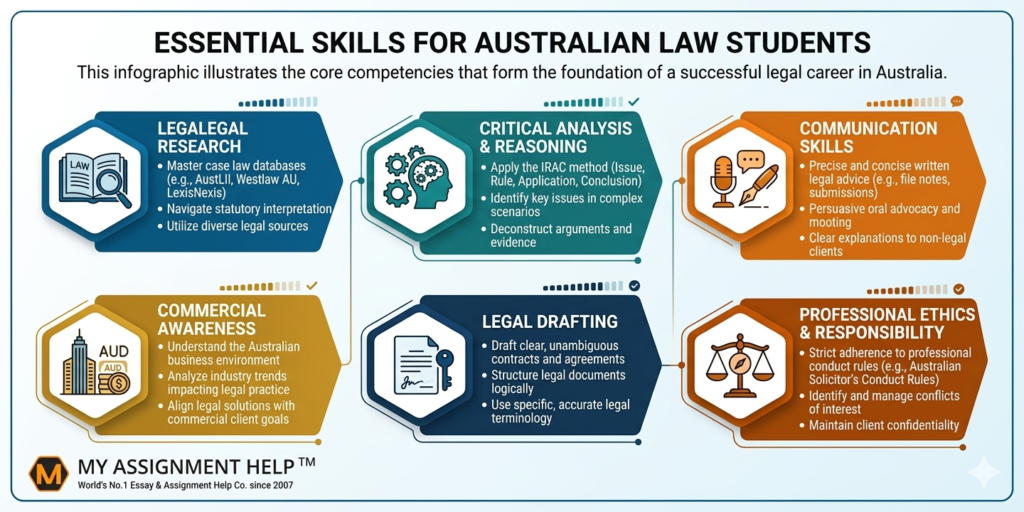
Critical Thinking and Legal Reasoning: The Foundation
This is the cornerstone of legal practice. It’s not just about knowing the law; it’s about how you apply it. Critical thinking in law involves:
- Analysing complex problems: Breaking down a fact scenario into its core legal issues.
- Identifying relevant facts: Sifting through information to determine what’s crucial and what’s irrelevant.
- Synthesising legal principles: Connecting relevant statutes, cases, and common law principles to form a coherent argument.
- Constructing logical arguments: Presenting your conclusions in a clear, concise, and persuasive manner.
- Evaluating competing interpretations: Anticipating counterarguments and developing strong rebuttals.
Australian courts, from the Local Court to the High Court, require a rigourous application of legal reasoning. The “IRAC” (Issue, Rule, Application, Conclusion) method is a standard tool for this, but mastering it takes practice. For example, when analysing a complex negligence case, you need to dissect each element of the duty of care, breach of duty, causation, and remoteness, using case law precedents to support your analysis.
Research and Information Literacy: Navigating the Legal Labyrinth
Law is a research-intensive field. You need to be a digital detective, capable of navigating databases like LexisNexis, Westlaw, and AustLII with precision. This isn’t just about typing in keywords; it’s about understanding search syntax, using citators to find subsequent cases, and knowing how to evaluate the authority of different sources.
Australian legal research has its own nuances. You need to be proficient in finding:
- Statutory law: The Acts and regulations enacted by Federal and State Parliaments.
- Case law: Judgments from courts at all levels, including unreported judgments.
- Secondary sources: Textbooks, journal articles, and commentary that explain and interpret the law.
- Government publications: Reports, inquiry findings, and explanatory memoranda.
Developing strong research skills will save you countless hours and ensure that your arguments are built on solid ground. And when the sheer volume of research for a complex problem becomes overwhelming, remember that seeking law assignment help from experienced legal professionals can provide valuable guidance and support.
Effective Communication: Written and Oral
Law is a communicative profession. You need to be able to express yourself clearly, concisely, and persuasively in both written and spoken forms.
- Written communication: This is crucial for assignments, exams, research papers, letters to clients, and formal legal documents like pleadings and affidavits. Australian legal writing emphasizes clarity, precision, and adherence to the AGLC.
- Oral communication: This includes everything from participating in class discussions and moots to presenting arguments in court and negotiating with opposing counsel. It requires clear articulation, confident delivery, and the ability to think on your feet.
Strong communication skills aren’t just about grammar and vocabulary; they’re also about empathy and cultural awareness. You need to be able to communicate complex legal concepts to clients from diverse backgrounds in a way they can understand.
Client Management and Emotional Intelligence
Law is a people business. You’ll be dealing with clients who are often going through stressful and challenging times. Emotional intelligence (EQ) is the ability to understand and manage your own emotions, as well as the emotions of others.
- Empathy: Putting yourself in your client’s shoes and understanding their perspective.
- Active listening: Paying close attention to what your client is saying, both verbally and non-verbally.
- Rapport-building: Establishing trust and confidence with your clients.
- Managing client expectations: Clearly explaining the legal process, the potential outcomes, and the costs involved.
Developing EQ will help you build stronger client relationships, manage difficult conversations, and provide more effective legal advice.
Time Management and Organization: Taming the Beast
Law school is a juggling act. You’ll have multiple assignments, exams, and readings all demanding your attention simultaneously. Effective time management and organization are essential for staying on top of your workload and avoiding burnout.
- Prioritisation: Identifying the most important and urgent tasks and tackling them first.
- Planning: Creating a realistic study schedule and sticking to it.
- Avoiding procrastination: Breaking down large tasks into smaller, more manageable steps.
- Managing distractions: Minimising interruptions and staying focused.
Organization is also key to effective legal research and writing. Keep meticulous notes, organize your research materials, and plan your writing carefully. If you find yourself overwhelmed by deadlines and unsure where to start, you might consider reaching out to services that offer to do my assignment, providing a helping hand when you need it most. This can be a strategic way to manage your workload and focus on mastering the other skills.
Essential Skills for Australian Law Students
| Skill | Description | Why it’s Critical |
| Critical Thinking | Analysing legal issues, synthesising principles, building arguments. | Foundational for legal reasoning and effective advocacy. |
| Research & Information Literacy | Navigating legal databases, evaluating sources. | Essential for building sound legal arguments based on authority. |
| Written & Oral Communication | Expressing legal concepts clearly and persuasively. | Key to engaging with courts, clients, and colleagues. |
| Client Management & EQ | Understanding and managing client emotions, building rapport. | Vital for effective client representation and business development. |
| Time Management & Organisation | Juggling multiple priorities, avoiding burnout. | Crucial for survival and success in law school and the profession. |
Author Bio
Sarah Jenkins is a Senior Legal Content Writer and Academic Mentor at MyAssignmentHelp Services. With a background in Australian law and a passion for legal education, Sarah provides expert guidance and academic support to law students across Australia. She is committed to helping the next generation of legal professionals develop the essential skills they need to thrive.
Key Takeaways
- Look beyond the statutes: Master critical thinking, communication, empathy, and time management.
- Embrace technology: Be a pro at legal research databases like LexisNexis, Westlaw, and AustLII.
- Communication is key: Develop strong written and oral communication skills, adhering to AGLC and focusing on clarity.
- Empathy and EQ matter: Understanding and managing emotions is crucial for client relationships.
- Don’t be afraid to ask for help: Time management and organization are essential, and resources like assignment help can provide strategic support.
FAQ
Q: Which skill is the most important for an Australian law student?
A: It’s difficult to single out one skill. All five are essential and interconnected. However, critical thinking provides the foundation upon which the other skills are built.
Q: How can I improve my communication skills?
A: Practice is key. Join moots, participate in class discussions, seek feedback on your writing, and consider public speaking courses. Read diverse materials to improve your vocabulary and sentence structure.
Q: I’m struggling with time management. What can I do?
A: Create a detailed schedule, prioritize tasks, break down large assignments, and use tools like calendars and task managers. Learn to say “no” to commitments that overload you.
Q: Where can I find help with my law assignments?
A: In addition to university resources like writing centers and academic support services, ethical and reputable academic assistance services like MyAssignmentHelp can provide valuable guidance and support. Always ensure you are using these services in compliance with your university’s academic integrity policies.
Sources & References
- Cook, C., Creyke, R., Geddes, R., & Hamer, D. (2021). Laying Down the Law (11th ed.). LexisNexis Butterworths.
- Melbourne University Law Review Association. (2018). Australian Guide to Legal Citation (4th ed.).
- Law Society of NSW. (2025). Mental Health and Wellbeing in the Legal Profession Report.
- Attorney-General’s Department. Acts Interpretation Act 1901 (Cth).
Author Bio
Dr. Helena Richardson Helena is a Senior Content Specialist and Academic Consultant at MyAssignmentHelp. With over 12 years of experience in Australian Jurisprudence and a PhD in Law from a leading Go8 university, she specializes in helping students navigate the complexities of Torts, Constitutional Law, and Equity. When she isn’t drafting high-level academic guides, she mentors junior writers on the importance of E-E-A-T in digital legal publishing.